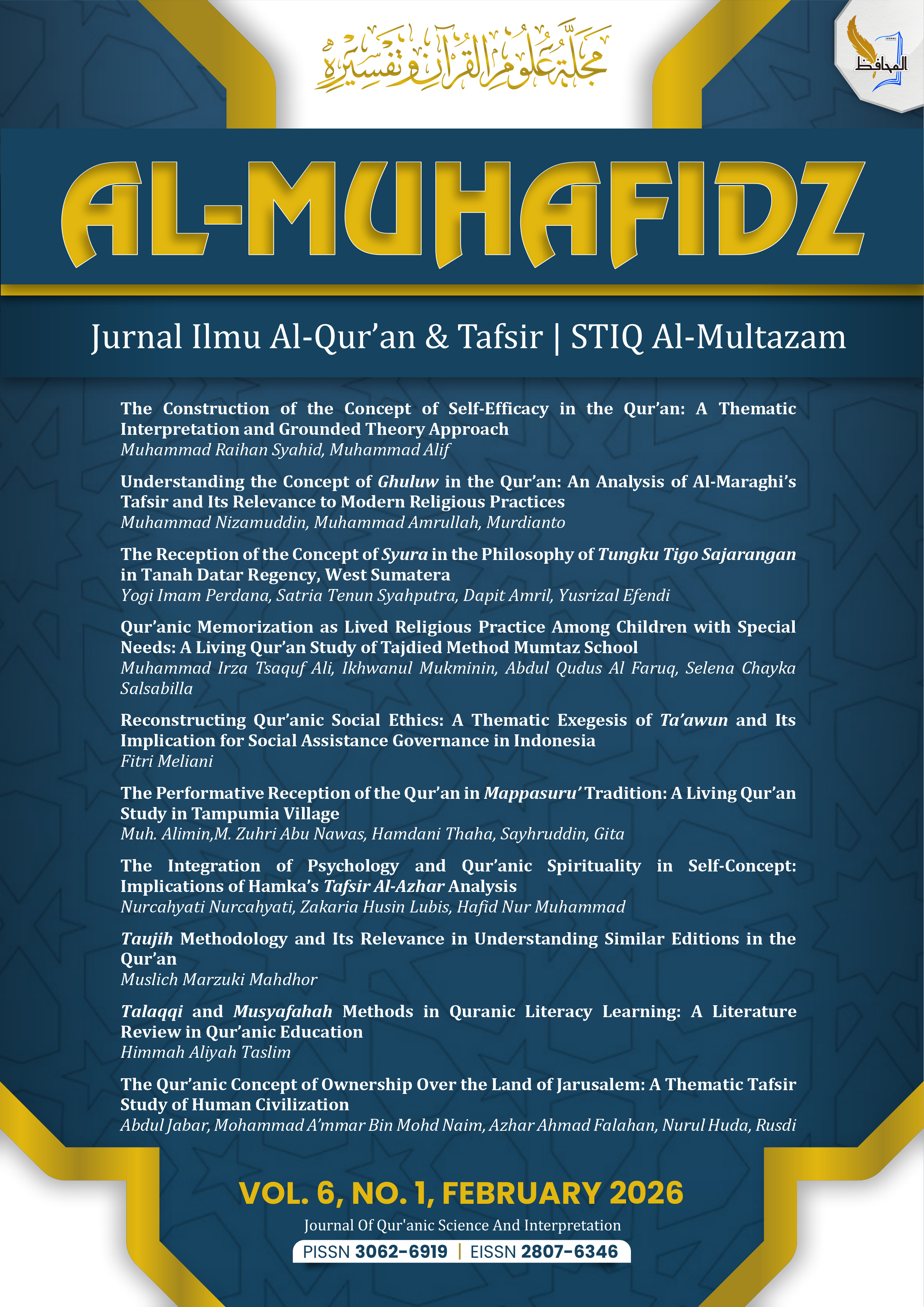
The Qur’anic Concept of Ownership Over the Land of Jerusalem: A Thematic Tafsir Study of Human Civilization
(Konsep Kepemilikan Qur’ani atas Tanah Yerusalem: Kajian Tafsir Tematik Sejarah Peradaban)
DOI:
https://doi.org/10.57163/vnemh131Keywords:
Jerusalem, Qur’anic Ownership, Thematic Exegesis, Divine SovereigntyAbstract
This study addresses the scholarly problem of the use of religious texts as a basis for territorial legitimization over Jerusalem in contemporary historical-political discourse. While numerous exegetical studies discuss the city’s sanctity and prophetic history, there remains no systematic conceptual formulation of a Qur’anic model of ownership and sovereignty over the territory. This absence constitutes the research gap addressed in this article. Employing a qualitative method through thematic exegesis (tafsir mawduʿi) grounded in conceptual analysis, the study examines Qur’anic verses related to al-arḍ, al-arḍ al-muqaddasah, and al-masjid al-aqṣa. These verses are analyzed in light of classical and contemporary interpretations and reconstructed to identify patterns of legitimacy, conditions of inheritance (warathah), the concept of istikhlaf, and mechanisms of mandate revocation in prophetic history. The findings reveal that the Qur’an articulates a theocentric and conditional concept of ownership: the earth belongs to God, while human authority constitutes a moral trusteeship subject to ethical evaluation and possible withdrawal. The study’s novelty lies in demonstrating that the Qur’an not only rejects ethnically grounded territorial claims but also corrects genealogical claims over Prophet Abraham as a foundation of territorial legitimacy by affirming that those closest to Abraham are Prophet Muhammad and those who uphold his monotheistic faith. Theoretically, this article proposes the model of Divine Conditional Sovereignty, a framework of delegated and morally contingent divine authority.
References
Al-Mahalli, Jalal al-Din, dan Jalal al-Din Al-Suyuti. Tafsir Jalalain. Vol. 1. Al-Haramain, 2007.
Al-Mahalli, Jalal al-Din, dan Jalal al-Din Al-Suyuti. Tafsir Jalalain. Vol. 2. Al-Haramain, 2007.
Al-Qurtubi, Muhammad ibn Ahmad. Al-Jami‘ li Aḥkam al-Qur’an. Vol. 6. Dar al-Kutub al-‘Ilmiyyah, 2006.
Al-Qurtubi, Muhammad ibn Ahmad. Al-Jami‘ li Aḥkam al-Qur’an. Vol. 10. Dar al-Kutub al-‘Ilmiyyah, 2006.
Al-Razi, Fakhr al-Din. Mafatiḥ al-Ghayb. Vol. 14. Dar Ihya’ al-Turath al-‘Arabi, 1999.
Al-Tabari, Abu Ja‘far Muhammad ibn Jarir. Jami‘ al-Bayan ‘an Ta’wīl Ay al-Qur’an. Vol. 1, disunting oleh Ahmad Muhammad Shakir. Mu’assasat al-Risalah, 2000.
Al-Tabari, Abu Ja‘far Muhammad ibn Jarir. Jami‘ al-Bayan ‘an Ta’wīl Ay al-Qur’an. Vol. 7, disunting oleh Ahmad Muhammad Shakir. Mu’assasat al-Risalah, 2000.
Ash-Shawi. Hasyiyah Ash-Shawi ‘Ala Tafsir Jalalain. Vol. 3. Al-Haramain, 2007.
Bidin, Sharifah Norshah Bani Syed, dan Ahmed S. A. Alqodsi. “The Responsibility of The Muslim Concerning the Rules and Ethics of Visiting Al-Aqsa Mosque.” International Journal of Academic Research in Business and Social Sciences 10, no. 4 (2020): Pages 621-626. https://doi.org/10.6007/IJARBSS/v10-i4/7160.
Fajri, Fadhilah Maulida, Siti Rokhani, dan Murdianto. “Keberkahan Bait al-Maqdis Dan Implementasinya Di Era Kontemporer: Telaah Dalam Perspetif Kitab Tafsir Al-Munir.” Ta’wiluna: Jurnal Ilmu Al-Qur’an, Tafsir Dan Pemikiran Islam 6, no. 2 (2025): 1033–45. https://ejournal.iaifa.ac.id/index.php/takwiluna/article/view/2450.
Fathia, Fifi, Mutiara Nazla Dalimunthe, Muhammad Fahrul Zikri, Nadia Silvia, Silfira Elisya Putri, dan Ramadhan Saleh Lubis. “Sejarah Tanah Terjanji Dalam Al-Qur’an: Sejarah Panjang Konflik Israel-Palestina Dan Dampaknya Terhadap Kehidupan Masyarakat Dunia.” Jurnal Intelek Dan Cendikiawan Nusantara 2, no. 5 (2025): 8307–16. https://jicnusantara.com/index.php/jicn/article/view/5211.
Finkelstein, Israel, dan Neil Asher Silberman. The Bible Unearthed: Archaeology’s New Vision of Ancient Israel and the Origin of Its Sacred Texts. Free Press, 2001.
Firdaus, Firdaus, Johan Septian Putra, Reni Saaulia, dan Sulfina Adnis. “Yasser Arafat dan Konflik Palestina-Israel (Tinjauan Sejarah).” Khazanah: Jurnal Sejarah dan Kebudayaan Islam 10, no. 1 (2020): 1–12. https://doi.org/10.15548/khazanah.v10i1.265.
Haryono, Eko. “Metodologi Penelitian Kualitatif Di Perguruan Tinggi Keagamaan Islam.” An-Nuur: The Journal of Islamic Studies 13, no. 2 (2023). https://doi.org/10.58403/annuur.v13i2.301.
Ibn ‘Ashur, Muhammad Tahir. Al-Tahrir wa al-Tanwir. Vol. 1. Dar al-Tunisiyyah li al-Nashr, 1984.
Ibn Kathir, Ismail. Tafsir al-Qur’an al-‘Adzim. Vol. 1, disunting oleh Sami ibn Muhammad Salamah. Dar Tayyibah, 1999.
Ibn Kathir, Ismail. Tafsir al-Qur’an al-‘Adzim. Vol. 2, disunting oleh Sami ibn Muhammad Salamah. Dar Tayyibah, 1999.
Ibn Kathir, Ismail. Tafsir al-Qur’an al-‘Adzim. Vol. 3, disunting oleh Sami ibn Muhammad Salamah. Dar Tayyibah, 1999.
Ibn Kathir, Ismail. Tafsir al-Qur’an al-‘Adzim. Vol. 5, disunting oleh Sami ibn Muhammad Salamah. Dar Tayyibah, 1999.
Ibn Kathir, Ismail. Tafsir al-Qur’an al-‘Adzim. Vol. 6, disunting oleh Sami ibn Muhammad Salamah. Dar Tayyibah, 1999.
Ibn Kathir, Ismail. Tafsir al-Qur’an al-‘Adzim. Vol. 7, disunting oleh Sami ibn Muhammad Salamah. Dar Tayyibah, 1999.
Mason, Steve. “Josephus and the Roman Destruction of Jerusalem.” Journal for the Study of Judaism 24, no. 1 (1993): 7–10.
Mir, Mustansir. Coherence in the Qur’an: A Study of Islahi’s Concept of Nazm. American Trust Publications, 1986.
Mujadidi, Haidar Ahmad, Samsul Ariyadi, dan Ade Naelul Huda. “Comparative Analysis of Kalam Interpretations of Bait Al-Maqdis Verses in Sunni, Mu’tazilah, and Shi’a Exegeses.” Suhuf: International Journal of Islamic Studies 37, no. 1 (2025): 225–36. https://doi.org/10.23917/suhuf.v37i1.8456.
Nawawi al-Jawi, Muhammad. Marah Labid li Kashf Ma‘na al-Qur’an. Vol. 2. Al-Hidayah, t.t.
Nur Hanifah, Fitrawati, dan Kusnadi. “Metodologi Tafsir Tematik.” Jurnal Al-Mubarak: Jurnal Kajian Al-Qur’an dan Tafsir 9, no. 2 (2024): 71–83. https://doi.org/10.47435/al-mubarak.v9i2.3313.
Omar, Abdallah Marouf. “Praying Towards Al-Aqsa Mosque: A Study On Muslim Classical Sources.” Journal of Al-Tamaddun 12, no. 2 (2017): 101–13. https://doi.org/10.22452/JAT.vol12no2.8.
Osman, Ahmad. Israel: Siapakah Mereka? Disunting oleh A. M. Halim. Fima Rodheta, 2008.
Prawira, Yudi. “Narasi Zionisme Dalam Klaim Atas Yerusalem Pada Masa Pemerintahan Benjamin Netanyahu.” Dinamika Global : Jurnal Ilmu Hubungan Internasional 4, no. 01 (2019): 123–57. https://doi.org/10.36859/jdg.v4i01.102.
Prayoga, Muhammad Abdy, Akhmad Sulthoni, Siti Rokhani, dan Muhammad Ainul Yaqin. “Penafsiran Ayat-Ayat Konflik Nabi Musa Dengan Bani Israil Dalam Tafsir Fî Zhilâlil.” Hamalatul Qur’an : Jurnal Ilmu Ilmu Alqur’an 5, no. 1 (2024): 9–15. https://doi.org/10.37985/hq.v5i1.68.
Rahmawati, Hanifah, dan Rezza Fauzi Muhammad Fahmi. “Konflik Perebutan Tanah Suci Tiga Agama Samawi dI Yarusalem (1980-2017 M).” Jazirah: Jurnal Peradaban dan Kebudayaan 3, no. 2 (2023): 168–79. https://doi.org/10.51190/jazirah.v3i2.93.
RI, Kementerian Agama dan LIPI. Tafsir ‘Ilmi. Vol. 13. Lentera Hati, 2002.
Ridwan, Ridwan. “Hak Milik atas Tanah dalam Perspektif Hukum Islam dan Hukum Pertanahan Indonesia.” Al-Manahij: Jurnal Kajian Hukum Islam 7, no. 2 (2013): 257–70. https://doi.org/10.24090/mnh.v7i2.568.
Saeed, Abdullah. Interpreting the Qur’an: Towards a Contemporary Approach. Routledge, 2006.
Sahidin, Amir. “Kedudukan Penting Bait al-Maqdis Bagi Umat Islam (Studi Analisis Historis).” Jurnal Penelitian Medan Agama 12, no. 1 (2021): 25. https://doi.org/10.58836/jpma.v12i1.9887.
Schmitt, Carl. Political Theology: Four Chapters on the Concept of Sovereignty. Disunting oleh George Schwab. MIT Press, 1985.
Shihab, M. Quraish. Tafsir Al-Misbah: Pesan, Kesan, dan Keserasian Al-Qur’an. Vol. 6. Lentera Hati, 2002.
Sulthoni, Akhmad, dan Muhamad Amrulloh. “Telaah Ayat-Ayat Pembebasan Bait al-Maqdis dalam Tafsir Al-Azhar.” Al Karima : Jurnal Studi Ilmu Al Quran dan Tafsir 7, no. 1 (2023): 24. https://doi.org/10.58438/alkarima.v7i1.149.
Suswanta, Suswanta. “Memahami Persoalan Palestina-Israel Dari Perspektif Islam.” Jurnal Hubungan Internasional 1, no. 1 (2012): 70–75. https://doi.org/10.18196/hi.2012.0008.70-75.
“The Fall and Rise of Jerusalem: Judah under Babylonian Rule.” Near Eastern Archaeology 68, no. 1–2 (2005): 3–6.
The Holy Bible: New Revised Standard Version. Zondervan, 1989.
Wiwana, Aisyatur Rahmah, Sholihah, dan Aziz Izroq. “Peristiwa Perpindahan Arah Kiblat Dalam Perspektif Al Quran Surah Al-Baqarah Ayat 142-145 Perspektif Tafsir Al-Misbah.” Gudang Jurnal Multidisiplin Ilmu 2, no. 6 (2024): 423–28. https://doi.org/10.59435/gjmi.v2i6.569.
Downloads
Published
Issue
Section
License
Copyright (c) 2026 Abdul Jabar, Mohammad A’mmar Bin Mohd Naim, Azhar Ahmad Falahan, Nurul Huda, Rusdi Rusdi

This work is licensed under a Creative Commons Attribution 4.0 International License.