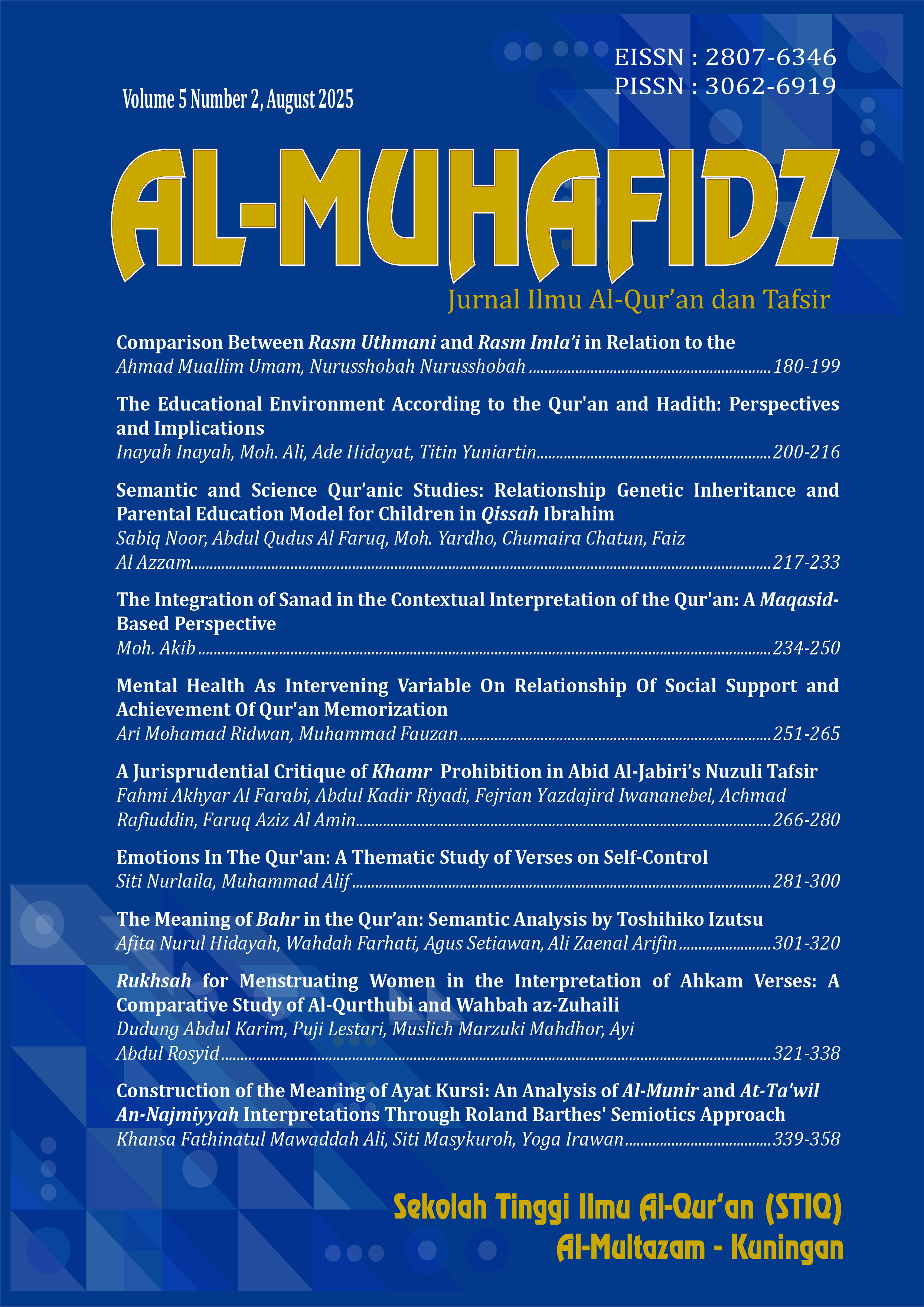
Rukhsah for Menstruating Women in the Interpretation of Ahkam Verses: A Comparative Study of Al-Qurthubi and Wahbah az-Zuhaili
(Rukhshah bagi Perempuan Haid dalam Perspektif Tafsir Ahkam: Studi Komparatif Kitab Al-Qurthubi dan Al-Munir Karya Wahbah Az-Zuhaili)
DOI:
https://doi.org/10.57163/almuhafidz.v5i2.254Keywords:
Al-Qurthubi, Comparative Tafsir, Menstruation, Rukhsah, Wahbah Az-ZuhailiAbstract
This study examines the concept of rukhsah (legal concession) for menstruating women as articulated in the Qur’an, through a comparative analysis of two prominent exegetical works: Al-Jamiʿ li Ahkam al-Qurʾan by Al-Qurthubi and Tafsir al-Munir by Wahbah az-Zuhaili. Employing a qualitative library research design and the tafsir muqaran approach formulated by ʿAbd al-Hayy al-Farmawi, the study identifies, collects, and interprets relevant Qur’anic verses addressing menstruation and legal dispensations. The findings reveal a shared recognition of certain ritual prohibitions—such as prayer, fasting, sexual intercourse, and tawaf—yet notable divergences emerge in their views on Qur’anic recitation, mosque entry, and ritual purity. Al-Qurthubi maintains a more restrictive legal stance grounded in classical fiqh, while az-Zuhaili offers a more contextualized interpretation informed by contemporary realities, including advances in hygiene and medical understanding. This study introduces a novel comparative hermeneutical framework that bridges traditional and modern perspectives, contributing to the discourse on gender-sensitive Qur’anic interpretation. It underscores the potential for a more inclusive and practical application of Islamic legal principles for menstruating women in the modern era.
References
Alza, Alza Nabiel Zamzami, Wahid Hakim Azzaky, Masrur Masrur, dan Lutfiyah Lutfiyah. “The Legal Analysis of Quranic Revision for Menstruating Women.” TOFEDU: The Future of Education Journal 3, no. 5 (2024): 1316–23. https://doi.org/10.61445/tofedu.v3i5.227.
Ash-Shabuni, Muhammad Ali. Rawa I’u al-Bayan Tafsir Ayat Ahkam min Al-Qur’an. Vol. 1. Keira, 2016.
Aziz, Nur, Mohd Tumiran, Hajar Opir, dan Noor Md Soh. “Islamic Menstrual Education in Malaysian Primary School: A Review of Prospects and Challenges.” Journal of Islamic Social Economics and Development 9 (Agustus 2024): 438–56. https://doi.org/10.55573/JISED.096541.
Buckley, Anisa, dan Susan Carland. “Triple Roles, Worship, and ‘Period Shaming’: How Muslim Women Maintain Belonging and Connection in Ramadan.” Journal for the Scientific Study of Religion 62, no. 4 (2023): 869–84. https://doi.org/10.1111/jssr.12873.
Farmawy, Abdul Hayy al-. al Bidayah fi al Tafsir al Mawḍū’i. terj. Surya A. Jamrah. Rajagrafindo Persada, 1996.
Gouvernet, B., F. Sebbe, P. Chapillon, A. Rezrazi, dan J. Brisson. “Period Poverty and Mental Health in Times of Covid-19 in France.” Health Care for Women International (England) 44, no. 5 (2023): 657–69. https://doi.org/10.1080/07399332.2022.2070625.
Hazm, Ibn. al-Muhalla. Vol. 1. terj. Syaikh Ahmad Muhammad Syakir. Pustaka Azzam, t.t.
Jauziyah, Ibnu Qayyim al-. I’lam al-Muqi’in an Rab al-Alamin. Vol. 3. Dar al ‘ilmiyah, 1999.
Jyothish, Kumar J., Shreya Shivangi, Amish Bibhu, Subhankar Mishra, dan Sulagna Saha. “MIMA 2.0 -- Compact and Portable Multifunctional IoT integrated Menstrual Aid.” Internet of Things 25 (April 2024): 1–31. https://doi.org/10.1016/j.iot.2024.101075.
Khoiroh, Isti, Agus Setiawan, dan Hafid Nur Muhammad. “KONSEP KEPEMIMPINAN WANITA DALAM QS. AN-NISA AYAT 34 (Studi Komparatif Tafsir Al-Jami’ Li Ahkam Al-Qur’an Karya Imam al-Qurthubi Dan Tafsir Kebencian Karya Zaitunah Subhan).” Al Muhafidz: Jurnal Ilmu Al-Qur’an Dan Tafsir 2, no. 2 (2022): 184–94. https://doi.org/10.57163/almuhafidz.v2i2.45.
Lahim, Shalih bin Abdullah al-. Al-Ahkamal Murattibah ‘Ala al-Haidhi wwa al-Niasi al-istishadati: Fiqih Darah Wanita. terj. Nurul Mukhlisin. Pustaka Elba, 2012.
Latifah, Hanik, dan Dzin Nun Naachy. “Pandangan Ulama Tentang Larangan Menyentuh dan Membaca Al-Qur’an dalam Keadaaan Haid.” At-Tahdzib: Jurnal Studi Islam dan Muamalah 11, no. 2 (2023): 73–83. https://doi.org/10.61181/at-tahdzib.v11i2.325.
Liza, Fitri, Teguh Luhuringbudi, Panggih Abdiguno, dan Dewi Nita Utami. “Application of Multidisciplinary Perspectives in The Study of Women’s Fiqh.” TATHO: International Journal of Islamic Thought and Sciences 2, no. 1 (2025): 36–52. https://doi.org/10.70512/tatho.v2i1.77.
Lukman, Jannah. “Kajian Fiqh Wanita Dasar tentang Haid dan Hukum yang Berkaitan dengannya pada Siswi Mtss Tahfidzul Qur’an Al- Azzam.” Catimore: Jurnal Pengabdian Kepada Masyarakat 1, no. 3 (2022): 9–20. https://doi.org/10.56921/cpkm.v1i3.18.
Madaniah, Fitri. “Hukum Tawaf Bagi Wanita Haid Menurut Mazhab Hanafi Dan Mazhab Syafi’i.” Ma’mal: Jurnal Laboratorium Syariah Dan Hukum 3, no. 2 (2022): 180–97. https://doi.org/10.15642/mal.v3i2.127.
MAZUZ, HAGGAI. “Revisiting Islamic Laws of Istiḥāḍa.” Journal of the Royal Asiatic Society 30, no. 2 (2020): 223–29. Cambridge Core. https://doi.org/10.1017/S1356186318000743.
Mulyana, Mulyana, Roswati Nurdin, dan H. Rajab. “Menggugat Larangan Wanita Haid Berdiam Dalam Masjid (Perbandingan Pandangan Imam al-Syafi’i dan Imam Ahmad).” Muqaranah 6, no. 2 (2022): 133–50. https://doi.org/10.19109/muqaranah.v6i2.14618.
Mumtazh, Zsazsa Hafidzah, dan Alisya Kimora Qurrota A’yun. “Keterkaitan Antara Larangan Berpuasa Bagi Wanita yang Sedang Haid dengan Kondisi Kesehatan.” Islamologi : Jurnal Ilmiah Keagamaan 1, no. 2 (2024). https://jipkm.com/index.php/islamologi/article/view/90/75.
Nurgat, Yahya. “Menstruation and the Ṭawāf al-Ifāḍa: A Study of Ibn Taymiyya’s Landmark Ruling of Permissibility.” Hawwa 20 (Februari 2020): 1–20. https://doi.org/10.1163/15692086-BJA10001.
Nuroniyah, Wardah. Fikih Menstruasi. Prenadamedia, 2020.
Nuroniyah, Wardah. “Menakar Ulang Diskursus Menstruasi: Kajian Atas Aturan Puasa Bagi Perempuan Haid Dalam Fikih Sebagai Upaya Menghapus Stereotype Dan Menstrual Taboo.” Al-Manahij: Jurnal Kajian Hukum Islam 16, no. 1 (2022): 59–76. https://doi.org/10.24090/mnh.v16i1.6317.
Pratama, Tommy, Hasman Muhammad, Syahmirwan Syahmirwan, dan Alfandi Safarsyah. “Managing Menstrual Cycle Medication During Hajj and Fasting: Juridical Considerations.” Research Horizon 3, no. 3 (2023): 172–81. https://journal.lifescifi.com/index.php/RH/article/view/116.
Proff, Alexandria Alisa, Surhan Fatima, dan Mónica Lorena Sánchez Limón. “Becoming Women: Period. Perceptions of Barriers and Facilitators to Menstrual Hygiene Management Programs for Pakistani Girls.” Frontiers in Public Health (Switzerland) 11 (2023): 1083688. https://doi.org/10.3389/fpubh.2023.1083688.
Qurthubi, Imam al-. Al-Jamiʿ li Ahkam al-Qurʾan. Vol. 1–3. Daar al-Fikr, t.t.
Qurthubi, Imam al-. Al-Jamiʿ li Ahkam al-Qurʾan. Vol. 3. Daar al-Fikr, t.t.
Qurthubi, Imam al-. Al-Jamiʿ li Ahkam al-Qurʾan. Vol. 12. Daar al-Fikr, t.t.
Qurthubi, Imam al-. Al-Jamiʿ li Ahkam al-Qurʾan. Vol. 14. Daar al-Fikr, t.t.
Rafi, Irsyad. “Golongan Yang Mendapatkan Rukhṣah Dalam Ibadah Puasa Dan Konsekuensi Hukumnya.” NUKHBATUL ’ULUM: Jurnal Bidang Kajian Islam 4, no. 2 (2018): 204–19. https://doi.org/10.36701/nukhbah.v4i2.47.
Ramdan, Aldi, Gitsa Yatna Arrashif, Ibnu Muhammad Hawari, Kahfi Maulana Nursadin, dan Budi Suhartawan. “The Menstrual Period in Qur’an: Interpretation of Al-Baqarah Verse 222.” Journal of Ulumul Qur’an and Tafsir Studies 2, no. 1 (2023): 25–30. https://doi.org/10.54801/juquts.v2i1.175.
Rusyd, Ibnu. Bidayatul Mujtahid: wa Nihayatul Muqtashid. Vol. 1. terj. Al-Mas’udah. Pustaka Al Kautsar, 2016.
Salehi, Ezzatollah, Mehrab Sadeghi, Azam Khoshsorat, dan Behrooz Haddadi. “An Analysis of Gender and Health in Islam.” Annals of Military and Health Sciences Research 18, no. 3 (2020). https://doi.org/10.5812/amh.105628.
Scheunchen, Tobias. “From Body to Substance: Islamic Menstruation Laws in the Shadow of Late Antiquity?” Islamic Law and Society (Leiden, The Netherlands) 32, no. 1–2 (2024): 1–42. https://doi.org/10.1163/15685195-bja10062.
Shihab, M. Quraish. Tafsir Al-Mishbah: Pesan, Kesan dan Keserasian Al-Qur’an. Vol. 1. Lentera Hati, 2002.
Umami, Khairul, dan Mega Puspita. “Gender Approach in Islamic Family Law.” An-Nisa Journal of Gender Studies 16, no. 1 (2023): 109–24. https://doi.org/10.35719/annisa.v16i1.169.
Wadud, Amina. Qur’an and Woman: Rereading the Sacred Text from a Woman’s Perspective. Oxford University Press, 1999.
Wailissa, Zainul. “BERSENGGAMA SAAT MENSTRUASI DALAM TINJAUAN AL-QUR’AN DAN SAINS.” TAHKIM 15, no. 2 (2019): 222–34. https://doi.org/10.33477/thk.v15i2.3060.
Zuhaili, Wahbah az-. Fiqh al-Islam wa Adillatuhu. Dar al-Fikr, 1997.
Zuhaili, Wahbah az-. Tafsir al-Munir fi al-ʿAqidah wa al-Syariʿah wa al-Manhaj. Vol. 1. Dar al-Fikr al-Mu’asir, 1998.
Zuhaili, Wahbah az-. Tafsir al-Munir fi al-ʿAqidah wa al-Syariʿah wa al-Manhaj. Vol. 2. Dar al-Fikr al-Mu’asir, 1998.
Zuhaili, Wahbah az-. Tafsir al-Munir fi al-ʿAqidah wa al-Syariʿah wa al-Manhaj. Vol. 5. Dar al-Fikr al-Mu’asir, 1998.
Zuhaili, Wahbah az-. Tafsir al-Munir fi al-ʿAqidah wa al-Syariʿah wa al-Manhaj. Vol. 14. Dar al-Fikr al-Mu’asir, 1998.
Downloads
Published
Issue
Section
License
Copyright (c) 2025 Dudung Abdul Karim, Puji Lestari, Muslich Marzuki Mahdhor, Ayi Abdul Rosyid

This work is licensed under a Creative Commons Attribution 4.0 International License.