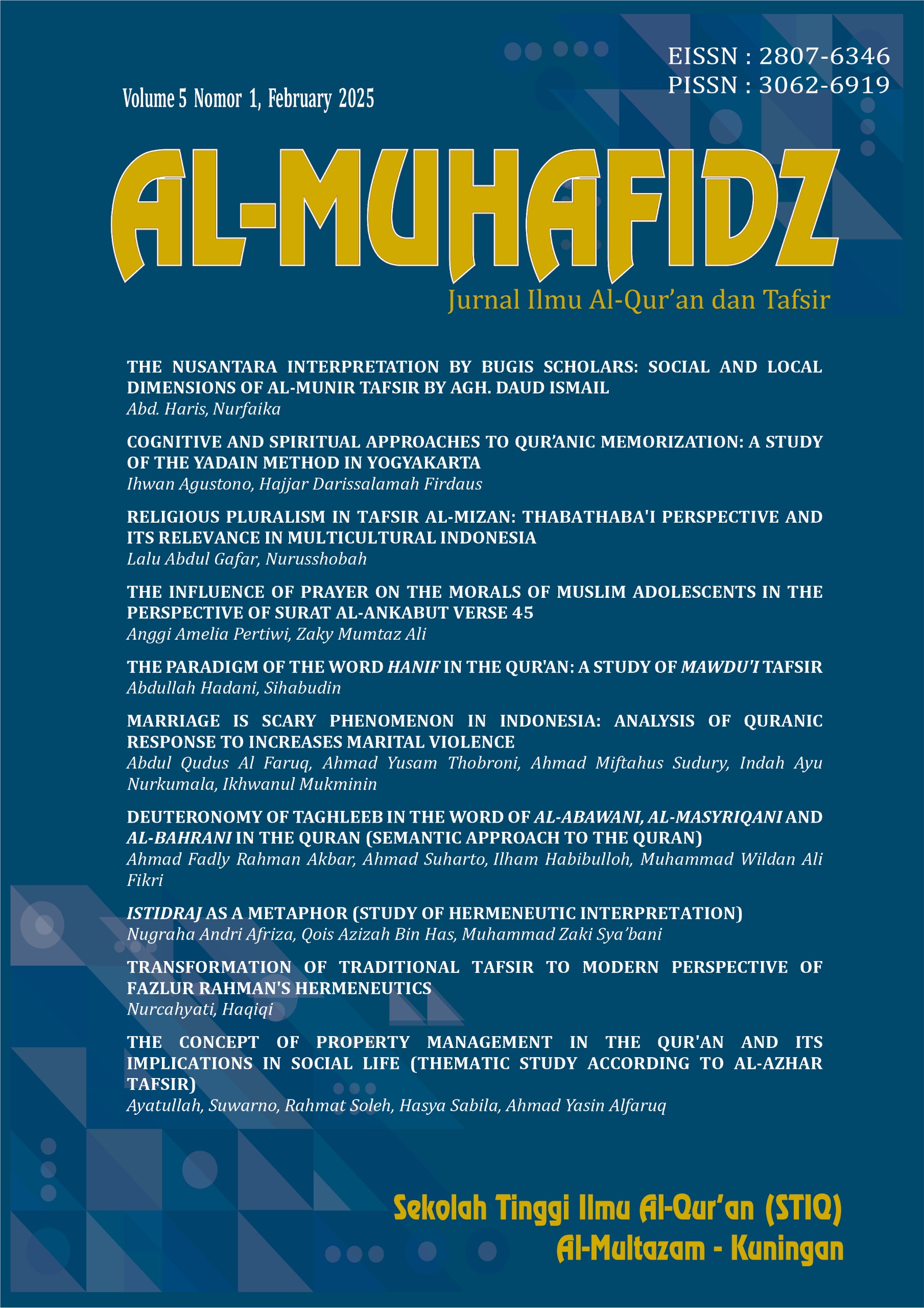
The Nusantara Interpretation By Bugis Scholars: Social And Local Dimensions Of Al-Munir Tafsir By Agh. Daud Ismail
DOI:
https://doi.org/10.57163/almuhafidz.v5i1.140Keywords:
Bugis , Locality, Nusantara , Social, TafsirAbstract
This essay explains the Nusantara interpretation, specifically the Al-Munir Tafsir authored by AGH Daud Ismail, a prominent Bugis scholar from South Sulawesi. The interpretation plays a significant role in conveying Quranic messages in alignment with the social conditions surrounding the exegete. This study aims to investigate and analyze selected Quranic verses, subsequently examining their significance within the local societal context. The research employs a qualitative methodology utilizing literary review techniques, with a focused analysis of the Bugis Al-Munir Tafsir. Moreover, a phenomenological approach is utilized to establish connections between textual interpretation and social contexts. The article’s findings reveal that AGH. Daud Ismail developed a contextual interpretation model that demonstrates profound sensitivity to the social dynamics of Bugis society. This is evident in the strategic selection of Lontarak linguistic expressions readily comprehensible to the Bugis community. This research discovered that the Al-Munir Tafsir transcends mere translation and interpretation of the Quran based on the exegete's immediate requirements; instead, its interpretative approach facilitates the community's understanding of the Quranic text. Specifically, this research highlights the author's utilization of local language and linguistic expressions as a methodological strategy to transform Quranic messages into the cultural reality of Bugis society. This study is anticipated to contribute to enriching the scholarly landscape of Nusantara tafsir studies by presenting an interpretation model that is responsively attuned to the social contexts of the Bugis community in South Sulawesi, with broader implications for advancing more contextual and inclusive interpretation methodologies.
References
Abdullah, M. Amin. “Islam as a Cultural Capital in Indonesia and the Malay World: A Convergence of Islamic Studies, Social Sciences and Humanities.” Journal of Indonesian Islam 11, no. 2 (2017): 307–28. https://doi.org/10.15642/JIIS.2017.11.2.307-328.
Akhmar, Andi Muhammad, Burhanuddin Arafah, and Wahyuddin Pardiman. “Strategi Budaya Orang Bugis Pagatan Dalam Menjaga Identitas Ke-Bugis-an Dalam Masyarakat Multikultur.” Kapata Arkeologi 13, no. 1 (2017): 73. https://doi.org/10.24832/kapata.v13i1.392.
Al-Khulli, Amin. Manahij Al-Tajdid. Mesir: An-Nadhlah Al-Mishriyah Al-’Ammah li Al-Kitab. 1995.
Al-Qaththan, Syaikh Manna’. Pengantar Studi Ilmu Al-Qur’an. Edited by LC Abduh Zulfidar Akaha, LC, Muhammad Ihsan. Cet. IV. Jakarta Timur: Pustaka AL-Kautsar, 2009.
Arief, Syamsuddin. “Aktor Pembentuk Jaringan Pesantren Di Sulawesi Selatan 1928-1952.” Lentera Pendidikan?: Jurnal Ilmu Tarbiyah Dan Keguruan 10, no. 2 (2007): 185–95. https://doi.org/10.24252/lp.2007v10n2a5.
Azriani, Alfin Nuri. Inter Relasi Al-Qur’an Dan Budaya Jawa Dalam Tafsir Al-Ibriz Karya Bisri Mustofa. Surabaya: Repository UIN Sunan Ampel, 2020.
Feener, R Michael. “Notes towards the History of Qur’anic Exegesis in Southase Asia.” Studi Islamika 5 (199AD).
Hanafi, Hasan. Hermeneutika Al-Qur’an. Yogyakarta: Pesantren Nawesea Press, 2009.
Herlena, Winceh, and Muads Hasri. “Unsur Lokalitas Dalam Tafsir Berbahasa Bugis Karya AGH. Daud Ismail (Studi Analisis Psychological Hermeneutics Terhadap QS. Al-Maidah 5:90).” El-Afkar: Jurnal Pemikiran Keislaman Dan Tafsir Hadis 9, no. 2 (2020): 239. https://doi.org/10.29300/jpkth.v9i2.3509.
Hude, M. Darwis. Logika Al-Qur’an; Pemaknaan Ayat Dalam Berbagai Tema. 1st ed. Cawang, Kramat Jati Jakarta Timur: Penerbit Eurabia PT Nagakusuma Media Kreatif, 2015.
Ismail, Daud. Tafsir Al-Munir. Juz 3. Ujung P andang: CV. Bintang Selatan, n.d.
Jamiluddin. “Transformasi Sosial Qur’anik Dalam Tafsir Al-Azhar.” Repositori Institut PTIQ Jakarta 8, no. 5 (2019): 55.
Khalifah, Sayyidah. “Tipologi Tafsir Alquran Di Indonesia Pasca Reformasi: Telaah Pribumisasi Al-Qur’an Karya M. Nur. Kholis Setiawan.” Mutawatir. Jurnal Keilmuan Tafsir Hadith 126, no. 1 (2019): 1–7.
Mabrur. “Era Digital Dan Tafsir Al Qur’an Nusantara: Studi Penafsiran Nadirsyah Hosen Di Media Sosial.” Prosiding Konferensi Integrasi Interkoneksi Islam Dan Sains 2 (2020).
Mahfudz, Muhsin. “Tafsir Al- Qur’an Berbahasa Bugis.” Al-Fikr 14, no. 3 (2010): 34.
Mayun Susandhika, I Gusti Ngurah. “Globalisasi Dan Perubahan Budaya: Perspektif Teori Kebudayaan Modern.” Jurnal Ilmiah Cakrawarti 1, no. 2 (2020): 1–6. https://doi.org/10.47532/jic.v1i2.10.
Muhyiddin Thahir. Pemikiran Akhlak AG. H. Daud Ismail Dalam Tafsir Al-Munir. Edited by Disertasi UIN. Makasar: (Universitas Islam Negeri Makassar), n.d.
Mursalim, Mursalim. “Pemikiran Teologi Ulama Bugis Dalam Tafsir Al-Qur’an Bahasa Bugis.” Al-Ulum 18, no. 2 (2018): 317–40. https://doi.org/10.30603/au.v18i2.552.
Rouf, Abdul. Mozaik Tafsir Indonesia Kajian Ensiklopedis Karya Tafsir Nusantara Dari Abdur Rauf As-Singkili Hingga Muhammad Quraish Shihab. I. Depok, Jawa Barat: Sahifa Publishing, 2020.
Sila, Muhammad Adlin. “As’Adiyah Pencetak Ulama Dan Pesantren Di Sulawesi Selatan.” EDUKASI: Jurnal Penelitian Pendidikan Agama Dan Keagamaan, 2017. https://doi.org/10.32729/edukasi.v3i3.221.
Syakhlani, M. Mufid. “Kajian Tafsir Nusantara: Tafsir Al-Qur’an Berbahasa Bugis (Ugi) Karangan AGH Daud Ismail.” Muharrik-Jurnal Dakwah Dan Sosial 1, no. 2 (2018): 1–25.
Wahyu Ari, Anggi Wahyu. “Sejarah Tafsir Nusantara.” Jurnal Studi Agama 3, no. 2 (2020): 113–27. https://doi.org/10.19109/jsa.v3i2.5131.
Yunus, Muhammad, M. Ghalib, and Muhammad Sadik Sabry. “Tafsir Bahasa Bugis AG. H. Daud Ismail: Aplikasi Penafsiran Dengan Metode Hida’i Tentang Al-Rijs.” Jurnal Tafsere 10, no. 1 (2023): 78–103. https://doi.org/10.24252/jt.v10i1.35552.
Yusuf, Muhammad. “Relevansi Nilai-Nilai Budaya Bugis Dan Pemikiran Ulama Bugis: Studi Atas Pemikirannya Dalam Tafsir Berbahasa Bugis Karya MUI Sulsel.” El-Harakah 15, no. 2 (2013): 201. https://doi.org/10.18860/el.v15i2.2766.
Downloads
Published
Issue
Section
License
Copyright (c) 2025 Abd. Haris Haris, Nurfaika Nurfaika

This work is licensed under a Creative Commons Attribution 4.0 International License.