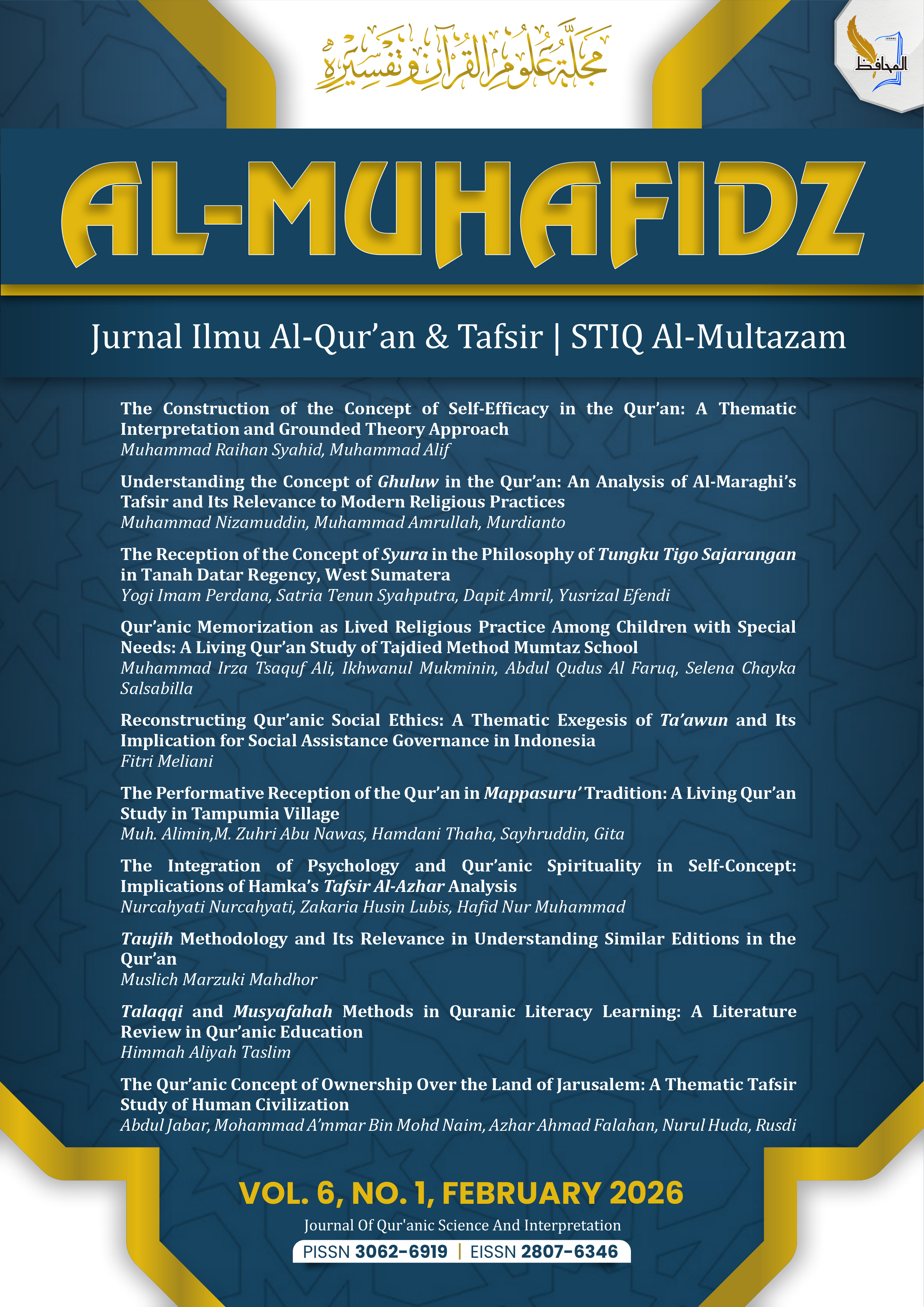
Qur’anic Memorization as Lived Religious Practice Among Children with Special Needs: A Living Qur’an Study of Tajdied Method Mumtaz School
DOI:
https://doi.org/10.57163/qf7ys844Keywords:
Children with Special Needs, Living Qur’an Studies, Qur’an Memorization, Tajdied MethodAbstract
Inclusive Qur’anic education demands pedagogical approaches that respond to the diverse cognitive, emotional, and sensory characteristics of children with special needs, as conventional memorization models often emphasize technical accuracy while overlooking how the Qur’an is experienced and embodied in daily learning. This study examines Qur’anic memorization as a lived religious practice through the implementation of the Tajdied Method at Mumtaz Elementary School, Sidoarjo. Using a qualitative case study design, data were collected through classroom observations, in-depth interviews with Qur’an teachers, inclusive facilitators, and students, as well as institutional documentation. The data were analyzed thematically within a living Qur’an framework. The findings reveal that the Tajdied Method—integrating rhythmic movement, melodic recitation, and mnemonic reinforcement—encourages affective involvement and embodied engagement with the Qur’an. Memorization is thus positioned not merely as a cognitive achievement but as an emotionally mediated and socially situated religious experience. Learning outcomes varied, influenced by attention span, sensory sensitivity, emotional regulation, and teacher–student interaction. This study contributes to living Qur’an scholarship by reframing Qur’anic memorization among children with special needs as an experiential, contextual, and socially embedded religious practice.
References
Abdillah, Teguh, and Taufik Churrahman. ‘Using the Tajdied Method to Improve Students’ Ability to Read the Qur’an’. KnE Social Sciences, 20 June 2022, 569–77. https://doi.org/10.18502/kss.v7i10.11259.
Anastasiou, Dimitris, Andrew L. Wiley, and James M. Kauffman. ‘A Critical Analysis of Theoretical Underpinnings of Universal Design for Learning’. Exceptionality 33, no. 3 (2025): 145–62. https://doi.org/10.1080/09362835.2024.2426801.
Assingkily, Muhammad Shaleh. ‘Living Qur’an as a Model of Islamic Basic Education in the Industrial Era 4.0’. Al Ibtida: Jurnal Pendidikan Guru MI 6, no. 1 (2019): 19. https://doi.org/10.24235/al.ibtida.snj.v6i1.3876.
Borgstede, Matthias, and Marcel Scholz. ‘Quantitative and Qualitative Approaches to Generalization and Replication–A Representationalist View’. Frontiers in Psychology 12 (February 2021): 605191. https://doi.org/10.3389/fpsyg.2021.605191.
Carbone, Paul S., Peter J. Smith, Charron Lewis, and Claire LeBlanc. ‘Promoting the Participation of Children and Adolescents With Disabilities in Sports, Recreation, and Physical Activity’. Pediatrics 148, no. 6 (2021): e2021054664. https://doi.org/10.1542/peds.2021-054664.
Chandra Wijaya, Adi. ‘The Effectiveness of Traditional and Modern Memorization Techniques for Quranic Learning in Indonesia’. Edu Spectrum: Journal of Multidimensional Education 1, no. 1 (2024): 38–47. https://doi.org/10.70063/eduspectrum.v1i1.27.
Cologon, Kathy. ‘Is Inclusive Education Really for Everyone? Family Stories of Children and Young People Labelled with “Severe and Multiple” or “Profound” “Disabilities”’. Research Papers in Education 37, no. 3 (2022): 395–417. https://doi.org/10.1080/02671522.2020.1849372.
Dalgaard, Nina T., Anja Bondebjerg, Bjørn C. A. Viinholt, and Trine Filges. ‘The Effects of Inclusion on Academic Achievement, Socioemotional Development and Wellbeing of Children with Special Educational Needs’. Campbell Systematic Reviews 18, no. 4 (2022): e1291. https://doi.org/10.1002/cl2.1291.
Diyal, Suresh Bahadur, and Romkant Pandey. ‘Components of a Research Proposal for the Field of Information and Communication Technology Education’. Innovative Research Journal 3, no. 2 (2024): 1–21. https://doi.org/10.3126/irj.v3i2.79471.
Hanum, Marsella Tria Amanda, Ahmad Isnaeni, and Yoga Irawan. ‘Implementation of the Values of Surah Al-Qamar (QS. 17, 22, 32 and 40) in the Tahfiz Development Program to Increase Motivation to Memorize for Basic Non-Pesantren Students’. ZAD Al-Mufassirin 7, no. 2 (2025): 536–57. https://doi.org/10.55759/zam.v7i2.334.
Hatch, J. Amos. Doing Qualitative Research in Education Settings. Second edition. State University of New York Press, 2023.
Jasim, Sara, and Adrienne Perry. ‘Repetitive and Restricted Behaviors and Interests in Autism Spectrum Disorder: Relation to Individual Characteristics and Mental Health Problems’. BMC Psychiatry 23, no. 1 (2023): 356. https://doi.org/10.1186/s12888-023-04766-0.
Khan, Nusrat, Fehmina Khalique, and Kartikay Saini. ‘Qualitative Research Methods: Harnessing Interviews, Focus Groups, Observations, and Document Analysis’. In Advances in Mechatronics and Mechanical Engineering, edited by Yeşim Kurt. IGI Global, 2025. https://doi.org/10.4018/979-8-3693-7403-0.ch002.
Leko, Melinda M., Bryan G. Cook, and Lysandra Cook. ‘Qualitative Methods in Special Education Research’. Learning Disabilities Research & Practice 36, no. 4 (2021): 278–86. https://doi.org/10.1111/ldrp.12268.
Lim, Weng Marc. ‘What Is Qualitative Research? An Overview and Guidelines’. Australasian Marketing Journal 33, no. 2 (2025): 199–229. https://doi.org/10.1177/14413582241264619.
Maisyanah, Arif Rahman, Nur Kholis, M. Yunus Abu Bakar, and Ali Akbar Al Hasan. ‘Living Qur’an Approach to Improve Critical Thinking Skills in Islamic Religious Education Learning’. Al-Hayat: Journal of Islamic Education 8, no. 4 (2024): 1383–98. https://doi.org/10.35723/ajie.v8i4.7.
Morgan, Hani. ‘Conducting a Qualitative Document Analysis’. The Qualitative Report, ahead of print, 2022. https://doi.org/10.46743/2160-3715/2022.5044.
Mowat, Harriet. ‘Interviews and Observation’. In The Wiley Blackwell Companion to Theology and Qualitative Research, 1st edn, edited by Pete Ward and Knut Tveitereid. Wiley, 2022. https://doi.org/10.1002/9781119756927.ch37.
Munhamir, Ahmad. ‘Tajdied Method Implementation In Improving The Quality Of Tahfidz Al-Quran Juz 30, 29, And 1 In Sd Muhammadiyah 10 Surabaya’. STUDIA RELIGIA: Jurnal Pemikiran Dan Pendidikan Islam 4, no. 2 (2020): 241–48.
Nurmaliyah, Yayah, Syamsul Aripin, and Nana Meily Nurdiansyah. ‘2013 Curriculum: Implementation of Islamic Religious Education Learning in Schools for Children with Special Needs’. International Journal of Islamic Thought and Humanities 2, no. 1 (2023): 124–38. https://doi.org/10.54298/ijith.v2i1.83.
Pandia, Weny Safitri S., Omar Lautzy, and Anson Drew. ‘Identifying and Solving Islamic Religious Education Challenges for Special Needs Children’. Assyfa Journal of Islamic Studies 1, no. 2 (2023). https://doi.org/10.61650/ajis.v1i2.321.
Paulus, Frank W., Susanne Ohmann, Eva Möhler, Paul Plener, and Christian Popow. ‘Emotional Dysregulation in Children and Adolescents With Psychiatric Disorders. A Narrative Review’. Frontiers in Psychiatry 12 (October 2021): 628252. https://doi.org/10.3389/fpsyt.2021.628252.
Rasyida, Hariantin Amirotur, and M. Asep Fathur Rozi. ‘Implementation of the Tajdid Method in Improving Reading and Memorization of the Qur’an by Students of Aisyiyah Kedungwaru Innovative Elementary School’. Edukasi 13, no. 01 (2025): 17–31. https://doi.org/10.54956/edukasi.v13i1.676.
Riviana, Natta and Arbi. ‘The Concept And Role Of Teacher Personality For Children With Special Needs In The Perspective Of The Qur’an’. Fikroh: Jurnal Pemikiran Dan Pendidikan Islam 17, no. 2 (2024): 111–19. https://doi.org/10.37812/fikroh.v17i2.1650.
Tafirenyika, Joice, Webster Mashiri, and Oliver Mavundutse. ‘Exclusion and Marginalisation in Inclusive Settings: The Experiences of a Child with a Disability’. In Towards Inclusive Education in Zimbabwe, edited by Tsediso Michael Makoelle and Tsitsi Chataika. Springer Nature Switzerland, 2025. https://doi.org/10.1007/978-3-031-66870-8_12.
Taufik, Riza Kurniawan, Rahimah Ibrahim, Haslinda Abdullah, and Hardani Widhiastuti. ‘Preserving Qur’an Through Blind Eyes: Self-Regulation of Blind People in Memorizing the Qur’an’. Journal of Disability & Religion 28, no. 1 (2024): 1–12. https://doi.org/10.1080/23312521.2022.2133788.
Vovchenko, Olha. ‘Emotional and Behavioural Reactions of High School Students with Special Educational Needs (Hearing Impairments) under Stress’. Scientific Bulletin of Mukachevo State University Series “Pedagogy and Psychology” 8, no. 3 (2022): 23–32. https://doi.org/10.52534/msu-pp.8(2).2022.23-32.
Yenduri, Gokul, Rajesh Kaluri, Dharmendra Singh Rajput, et al. ‘From Assistive Technologies to Metaverse: Technologies in Inclusive Higher Education for Students with Specific Learning Difficulties’. Version 1. Preprint, arXiv, 2023. https://doi.org/10.48550/ARXIV.2305.11057.
Zweers, Inge, Rens A. G. J. Van De Schoot, Nouchka T. Tick, et al. ‘Social–Emotional Development of Students with Social–Emotional and Behavioral Difficulties in Inclusive Regular and Exclusive Special Education’. International Journal of Behavioral Development 45, no. 1 (2021): 59–68. https://doi.org/10.1177/0165025420915527.
Downloads
Published
Data Availability Statement
mengenai data karya ilmiah kami beberapa ada dari wawancara dan jurnal atau buku ilmiah, adapun data jurnal insya Allah telah tertulis alamat DOI nya di daftar pustaka, adapun data wawancara secara tulisan ada pada tulisan bahan wawancara.
Issue
Section
License
Copyright (c) 2026 Muhammad Irza Tsaquf Ali, Ikhwanul Mukminin, Abdul Qudus Al Faruq, Selena Chayka Salsabilla

This work is licensed under a Creative Commons Attribution 4.0 International License.