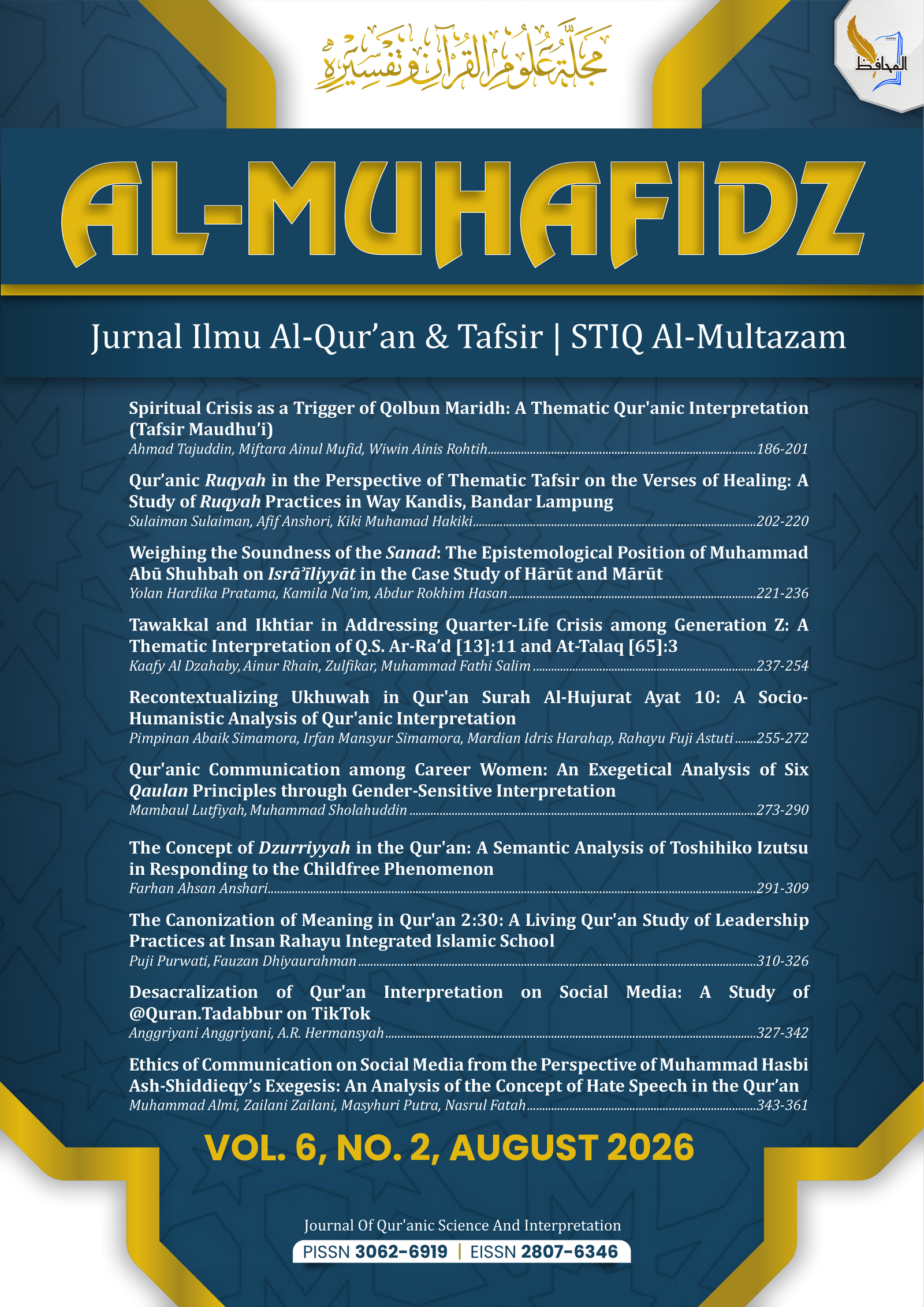
The Concept of Dzurriyyah in the Qur'an: A Semantic Analysis of Toshihiko Izutsu in Responding to the Childfree Phenomenon
Konsep Dzurriyyah dalam Al-Qur’an: Analisis Semantik Toshihiko Izutsu dalam Menanggapi Fenomena Childfree
DOI:
https://doi.org/10.57163/z4h7nn51Keywords:
Childfree, Dzurriyyah , Qur'anic Semantics , Qur'anic Worldview , Toshihiko IzutsuAbstract
The Qur'anic term dzurriyyah is closely related to lineage, succession, and the continuity of faith. This study aims to reconstruct the semantic meaning and Qur'anic worldview of dzurriyyah using Toshihiko Izutsu's semantic approach and examine its relevance to contemporary discussions on voluntary childfree. This qualitative library research analyzes Qur'anic verses containing dzurriyyah, supported by classical Arabic dictionaries, Qur'anic commentaries, and relevant studies. Data were collected through documentation and analyzed using Izutsu's framework, including basic meaning, relational meaning, semantic field, and Qur'anic worldview reconstruction. The findings indicate that dzurriyyah does not merely refer to biological descendants but encompasses the continuity of faith, transmission of monotheism, leadership regeneration, moral responsibility, and preservation of the prophetic mission. Unlike other Qur'anic terms for offspring, dzurriyyah emphasizes the quality and religious role of future generations as inheritors of divine values. The Qur'anic worldview therefore presents offspring as both a divine trust (amānah) and a means of sustaining religion and civilization. This semantic reconstruction provides a conceptual framework for understanding voluntary childfree within the broader Qur'anic perspective. The study concludes that dzurriyyah is fundamentally oriented toward the formation of righteous generations as a foundation for maintaining the continuity of the Muslim community and its values.
References
Almaany. “ذُرِّيَّة.” المعاني (Almaany), 27 Juni 2026. https://www.almaany.com/quran-b/ذرية/.
Al-Mahalli, Jalal al-Din Muhammad ibn Ahmad ibn Muhammad ibn Ibrahim, dan Jalal al-Din Abd al-Rahman ibn Abi Bakr Al-Suyuti. Tafsir al-Jalalayn. Vol. 1. Dar al-Hadith, 2001.
Al-Sa’di, Abd al-Rahman ibn Nasir ibn Abd Allah. Taysir al-Karim al-Rahman fi Tafsir Kalam al-Mannan. 1 ed. Edited by Abd al-Rahman ibn Mu’alla Al-Luwayhiq. Vol. 1. Mu’assasah al-Risalah, 2000.
Amir ibn al-Tufayl al-Amiri. Diwan Amir ibn al-Tufayl. 1 ed. Edited by Abu Bakr Muhammad ibn al-Qasim Al-Anbari. Vol. 1. Dar Sader, 1979.
Badrun, Muhammad, Alhafidh Nasution, Azizatul Afini, dan Evi Nurdiana. “The Basic Structure of Quranic Worldview: An Analysis to Toshihiko Izutsu Concept of Weltanschauung.” AL QUDS: Jurnal Studi Alquran Dan Hadis 7, no. 1 (2023): 191–208. https://doi.org/10.29240/alquds.v7i1.5696.
Darmawan, Dadang, Irma Riyani, dan Yusep Mahmud Husaini. “Desain Analisis Semantik Alquran Model Ensiklopedik: Kritik atas Model Semantik Toshihiko Izutsu.” AL QUDS: Jurnal Studi Alquran dan Hadis 4, no. 2 (2020): 181–206. https://doi.org/10.29240/alquds.v4i2.1701.
Euis; Mursalin, Hisan Zakiyyah. “Fenomena Childfree dalam Perspektif Islam.” Mauriduna: Journal of Islamic Studies 4, no. 2 (2023): 192–203. https://doi.org/10.37274/mauriduna.v4i2.840.
Fachrurrozi, Aziz. Memahami Ajaran Pokok Islam dalam Al-Qur’an melalui Kajian Semantik. 1 ed. PT Pustaka Al Husna Baru, 2004.
Fadhilah, Eva. “Childfree Dalam Perspektif Islam.” Al-Mawarid Jurnal Syariah Dan Hukum (JSYH) 3, no. 2 (2021): 71–80. https://doi.org/10.20885/mawarid.vol3.iss2.art1.
Faradiella, Elvynanda, dan Kharis Nugroho. “Konstelasi Makna Mahabbah Dan Raghiba Dalam Al-Quran: Analisis Semantik Toshihiko Izutsu.” Syntax Literate ; Jurnal Ilmiah Indonesia 10, no. 2 (2025): 1144–57. https://doi.org/10.36418/syntax-literate.v10i2.56801.
Fiddaraini, Mislannada, F. N. U. Yusroh, Rika Astari, dan Abdul Mukhlis. “The Meaning of Khalaqa and Its Derivation in Surah Ar-Rum (Semantic Analysis of Toshihiko Izutsu).” IJAS: Indonesian Journal of Arabic Studies 4, no. 2 (2022): 191–209. https://doi.org/10.24235/ijas.v4i2.11283.
Fitria, Riri. “Analysing The Understanding Of Childfree Practitioners From Islamic Academia On The Hadith About Multiplying Offspring.” Jurnal Ushuluddin 32, no. 2 (2024): 222–33. https://doi.org/10.24014/jush.v32i2.32406.
Harahap, Ikhwanuddin, Fatahuddin Aziz Siregar, dan Erie Hariyanto. “Understanding The Rise of Childfree Marriage: Avoiding Toxic Family, Being Happy and Well Without Children Despite Contradiction With Maqashid al-Sharia.” Al-Istinbath: Jurnal Hukum Islam 10, no. 1 (2025): 303–29. https://doi.org/10.29240/jhi.v10i1.9984.
Ibn Kathir, Abu al-Fida Ismail ibn Umar. Tafsir al-Qur’an al-’Azim. 2 ed. Vol. 3, disunting oleh Sami ibn Muhammad Salamah. Tafsir Ibn Kathir. Dar Tayyibah li-l-Nashr wa al-Tawzi’, 1999.
Ibn Manzur, Muhammad ibn Mukarram ibn Ali, Abu al-Fadl Jamal al-Din al-Ansari al-Ruwayfi’i al-Ifriqi. Lisan al-’Arab. 3 ed. Vol. 4. Dar Sader, 1414.
Indarta, Muhammad, dan Imanuddin Abil Fida. “Childfree Dalam Perspektif Islam Dan Sosiologi.” USRAH: Jurnal Hukum Keluarga Islam 4, no. 1 (2023): 46–67. https://doi.org/10.46773/usrah.v4i1.633.
Izutsu, Toshihiko. Ethico-Religious Concepts in the Qur’an. Reprint. Vol. 1. McGill-Queen’s University Press, 2002. https://doi.org/10.1515/9780773570511.
Izutsu, Toshihiko. God and Man in the Qur’an: Semantics of the Qur’anic Weltanschauung. 2 ed. Islamic Book Trust, 2008.
Kallang, Abdul. “Konsep Keturunan Menurut Al-Quran.” AL-WAJID: JURNAL ILMU AL-QURAN DAN TAFSIR 5, no. 2 (2024). https://doi.org/10.30863/alwajid.v5i2.5744.
Khasanah, Uswatul, dan Muhammad Rosyid Ridho. “Childfree Perspektif Hak Reproduksi Perempuan Dalam Islam.” Al-Syakhsiyyah: Journal of Law and Family Studies 3, no. 2 (2021): 104–28. https://doi.org/10.21154/syakhsiyyah.v3i2.3454.
Maulani, Mira Pitriani, Asep Sopian, dan Hikmah. “Weltanschauung Nūr Dalam Al-Qur’an: Analisis Semantik Toshihiko Izutsu Dan Refleksi Nilai Pendidikan.” Tsaqofiya : Jurnal Pendidikan Bahasa Dan Sastra Arab 7, no. 2 (2025): 630–58. https://garuda.kemdiktisaintek.go.id/documents/detail/5950440.
Muklisin, Muklisin. “The Kafaah Concept of the Sakinah Family in Muslim Generation Based on Islamic Law.” Jurnal Pembaharuan Hukum 10, no. 1 (2023): 148–64. https://doi.org/10.26532/jph.v10i1.31487.
Mumtazah, Niha Barrah, Ali Zaenal Arifin, dan Suwarno Suwarno. “Analisis Semantik Toshihiko Izutsu Pada Lafadz Al-Hubb Dalam Al-Qur’an.” Al Muhafidz: Jurnal Ilmu Al-Qur’an Dan Tafsir 3, no. 2 (2023): 164–78. https://doi.org/10.57163/almuhafidz.v3i2.81.
Mustaqim, Abdul. “Berbagai Penyebutan Anak Dalam Al-Qur’an: Implikasi Maknanya Dalam Konteks Qur’anic Parenting.” Jurnal Lektur Keagamaan 13, no. 1 (2015): 265–92.
Nukhbah min Asatidhat al-Tafsir. Al-Tafsir al-Muyassar. 2 ed. Majma’ al-Malik Fahd li-Tiba’at al-Mushaf al-Sharif, 2009.
Nurhasnah, Syafruddin, dan Rehani. “Kedudukan Anak Dalam Al-Quran Serta Implikasinya Dalam Pendidikan Islam.” ISLAM EDU : Jurnal Ilmiah Pendidikan Agama Islam 1, no. 02 (2023): 59–67. https://doi.org/10.51614/islam.
Rida, Ahmad al-Amili. Mu’jam Matn al-Lughah: Mawsu’ah Lughawiyyah Hadithah. Vol. 2. Dar Maktabat al-Hayah, 1958.
Saogi, Ahmad, Mesraini Mesraini, dan M. Reza Saputa. “Analisis Fenomena Childfree Dalam Perspektif Maqāṣid Al-Syāri’ah Sebagai Landasan Hukum Keluarga Islam Di Indonesia.” AL-MUSTAQBAL: Jurnal Agama Islam 2, no. 3 (2025): 157–76. https://doi.org/10.59841/al-mustaqbal.v2i3.215.
Sari, Nurindah, dan Dadan Rusmana. “Interpretasi Ayat-Ayat Pendidikan Anak Dalam Al-Qur’an Dan Implementasinya Dalam Keluarga: Studi Tafsir Maudhuí.” Gunung Djati Conference Series 8 (Januari 2022): 327–46. https://doi.org/10.15575/gdcs.v8i.576.
Shultony, Djamaluddin As, dan Zakiyatul Ulya. “Childfree Perspektif Teori Liberalisme Klasik, HAM, Dan Hukum Islam.” Insight: Indonesian Journal of Social, Humanity, and Education 1, no. 3 (2025): 148–60. https://doi.org/10.70742/insight.v1i3.520.
Tohirin. Metode Penelitian Kualitatif dalam Pendidikan dan Bimbingan Konseling. Cetakan 1. PT RajaGrafindo Persada, 2012. https://www.rajagrafindo.co.id/produk/metode-penelitian-kualitatif-dalam-pendidikan-dan-bimbingan-konseling-tohirin/.
Downloads
Published
Data Availability Statement
The data supporting the findings of this study are available within the article and from the cited references. No additional datasets were generated or analyzed during the current study.
Issue
Section
License
Copyright (c) 2026 Farhan Ahsan Anshari

This work is licensed under a Creative Commons Attribution 4.0 International License.