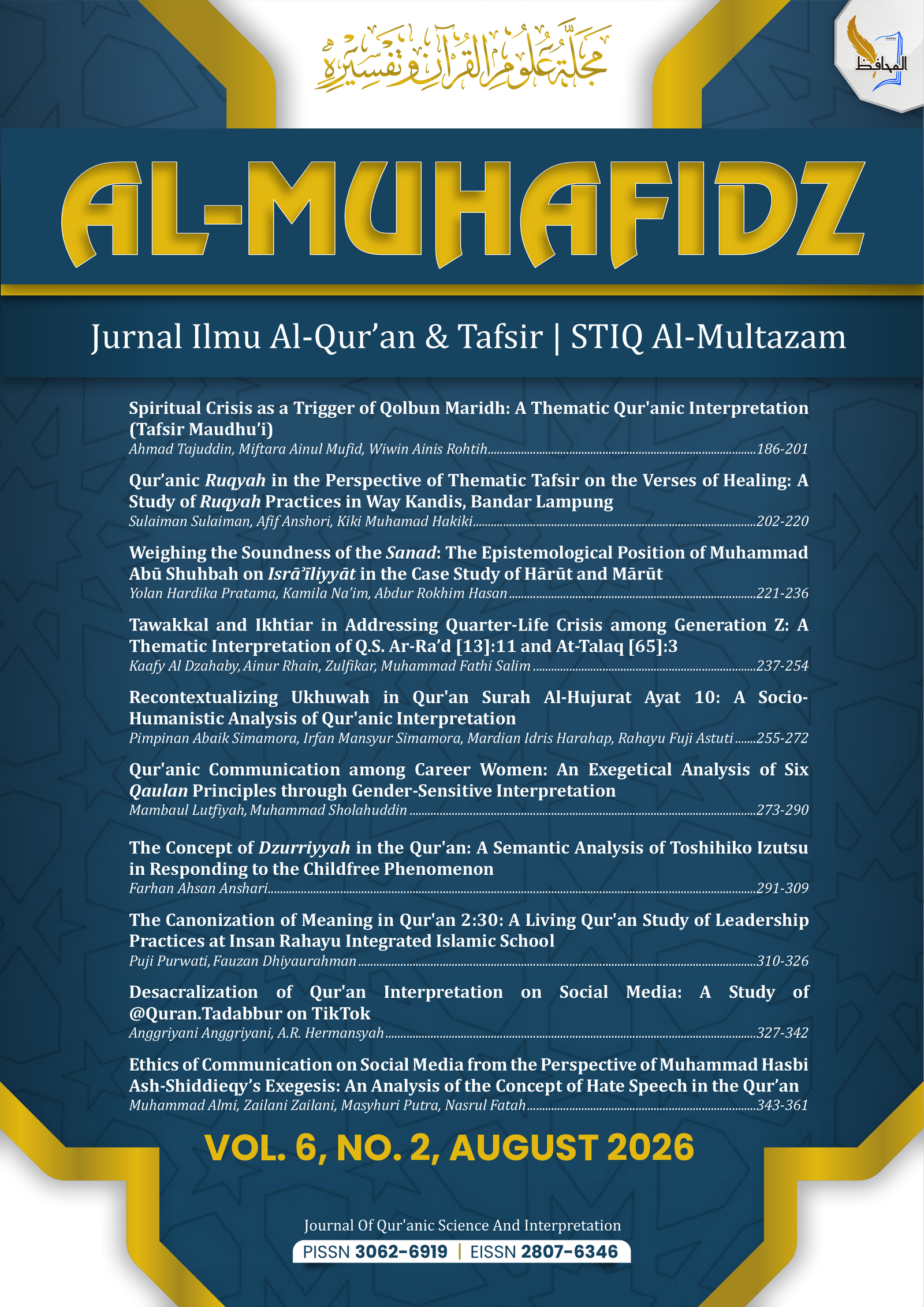
Desacralization of Qur'an Interpretation on Social Media: A Study of @Quran.Tadabbur on TikTok
DOI:
https://doi.org/10.57163/6b01tx04Keywords:
Desacralization of Meaning, Digital Interpretation, TikTok @quran.tadabburAbstract
The phenomenon of digital interpretation is increasingly showing the way young Indonesian Muslims view the Qur'an. With short video platforms such as TikTok, which accommodates to present the meaning of the Qur'an in a concise and fragmented manner. This study examined the TikTok account @quran.tadabbur which showed a meaning-loss interaction and will see the extent to which interpretive idealism can be maintained on social media. Using a descriptive-qualitative approach and content analysis, combined with elements of netnographic observation of publicly available social media data with the three most viewed videos (May-June 2025) compared to Tafsir al-Misbah and other classic tafsir works. The results of the study show that the short clip format tends to cut the verse from its historical background and use irrelevant decorative background images, resulting in a superficial and truncated meaning. In conclusion, the delivery of tafsir on TikTok risks simplifying the message of the Qur'an which is just a short moral message, although this risk can be reduced if you create content sequentially and consistently, such as listing clear reference sources, similar to activities carried out by @anugerahwulandari account. The novelty of this study is in mapping the forms of superficial digital meaning as well as a direct comparison between TikTok content and an authoritative book of exegesis.
References
Aziz, Abdul, and Diayah Sofarwati. “Kajian Tafsir Al-Mishbah Karya Muhammad Quraish Shihab.” BAHTSUNA: Jurnal Penelitian Pendidikan Islam 3, no. 1 (2021): 1–14. https://doi.org/10.55210/bahtsuna.v3i1.41.
Campbell, Heidi A. Digital Religion: Understanding Religious Practice in New Media Worlds. Illustrated. Routledge, 2013.
Farhan, Muhammad, and FItri Yeni M. Dalil. “Living Qur`an Di Media Sosial: Analisis Akun Instagram @Tadabburquranid.” Lathaif: Literasi Tafsir, Hadis Dan Filologi 3, no. 2 (2024): 165–77. https://doi.org/10.31958/lathaif.v3i2.13696.
Fikriyati, Ulya. “Pengarusutamaan Islam Moderat Melalui Penafsiran Al-Qur’an Di Media Sosial Indonesia.” Nun: Jurnal Studi Alquran Dan Tafsir Di Nusantara 8, no. 2 (2022): 179–200. https://doi.org/10.32495/nun.v8i2.330.
Hairul, Moh Azwar. “Tafsir Al-Qur’an Di Youtube: Telaah Penafsiran Nouman Ali Khan Di Channel Bayyinah Institute Dan Quran Weekly.” Al-Fanar : Jurnal Ilmu Al-Qur’an Dan Tafsir 2, no. 2 (2019): 197–213. https://doi.org/10.33511/alfanar.v2n2.197-213.
Ibn Kathīr, Ismāʿīl ibn ʿUmar. Tafsīr al-Qurʾān al-ʿAẓīm. 2nd ed. Vol. 4, edited by Sāmī ibn Muḥammad al-Salāmah. Dār Ṭayyibah li al-Nashr wa al-Tawzīʿ, 1999.
Ibn Kathīr, Ismāʿīl ibn ʿUmar. Tafsīr al-Qurʾān al-ʿAẓīm. 2nd ed. Vol. 5, edited by Sāmī ibn Muḥammad al-Salāmah. Dār Ṭayyibah li al-Nashr wa al-Tawzīʿ, 1999.
Ibn Kathīr, Ismāʿīl ibn ʿUmar. Tafsīr al-Qurʾān al-ʿAẓīm. 2nd ed. Vol. 7, edited by Sāmī ibn Muḥammad al-Salāmah. Dār Ṭayyibah li al-Nashr wa al-Tawzīʿ, 1999.
Ibn Kathīr, Ismāʿīl ibn ʿUmar. Tafsīr al-Qurʾān al-ʿAẓīm. 2nd ed. Vol. 8, edited by Sāmī ibn Muḥammad al-Salāmah. Dār Ṭayyibah li al-Nashr wa al-Tawzīʿ, 1999.
Jannah, Roudlotul, and Ali Hamdan. “Tafsir Al-Quran Media Sosial: Kajian Terhadap Tafsir Pada Akun Instagram @Quranriview Dan Implikasinya Terhadap Studi al-Quran.” Mashahif: Journal of Qur’an and Hadits Studies 1, no. 1 (2021). https://urj.uin-malang.ac.id/index.php/mashahif/article/view/781.
Jaza, Fandi Khusnul, and Anisa Dwi Makrufi. “The Effectiveness of TikTok as an Online Learning Platform for Islamic Education.” JIE (Journal of Islamic Education) 10, no. 1 (2025): 353–77. https://doi.org/10.35723/jie.v10i1.638.
Latif, Khusna Haibati, Hanif Cahyo Kistoro, Syafira Intan Muhliana, and Prima Rosita Sari. “The Effects of Social Media Use Intensity on Student’s Religious Knowledge in Yogyakarta.” Al-Tadzkiyyah: Jurnal Pendidikan Islam 14, no. 2 (2023): 213–29. https://doi.org/10.24042/002023141420200.
Mirzan, Muhammad, and Azrianti Ishamiyah. “Revolusi Penafsiran Al-Qur’an Membuka Makna Di Era Digital.” AL - Ghaaziy : Jurnal Ilmu Al-Qur’an Dan Tafsir 1, no. 1 (2025): 72–88. https://jurnalinspirasimodern.com/index.php/AL-Ghaaziy/article/view/142.
Miski, Miski, and Putri Ghoida’ Habibillah. “Alteration of Hadith Functions in TikTok Social Media.” Jurnal Living Hadis 7, no. 1 (2022): 97–120. https://doi.org/10.14421/livinghadis.2022.4002.
Nasution, Suryadi, Kholidah Nur, Khairurrijal Khairurrijal, and Ali Jusri Pohan. “Beyond the Mosque: Social Media as A New Frontier for Islamic Moral Education.” Al Ulya: Jurnal Pendidikan Islam 10, no. 1 (2025): 81–102. https://doi.org/10.32665/alulya.v10i1.4137.
Ngatipan, Billy Martasandy, Masruroh Lubis, Agus Burhan, and Permata Ika Hidayati. “Religious Influencer Dan Transformasi Otoritas Keagamaan Remaja Muslim Di Yogyakarta.” Jurnal Pendidikan Dasar Islam 4, no. 2 (2026): 311–26. https://doi.org/10.58540/jurpendis.v4i2.1811.
Nurfadillah, Arnita Nurul Sahrani, Suriyani Musi, Ahmad Fadil Muas, and Muh Aidil Fitrah. “Analisis Pesan Visual dan Verbal dalam Konten Tiktok: Studi pada Tren Edukasi Singkat.” Jurnal Teknologi Pembelajaran Interaktif 5, no. 4 (2025). https://journalversa.com/s/index.php/jtpi/article/view/4819.
Qutb, Sayyid. Fī Ẓilāl al-Qurʾān. 17th ed. Vol. 3. Dār al-Shurūq, 1992.
Rafsanjani, Muhammad, Muhammad Arwani Rofi’i, and Ulfatul Halimah. “Transformasi Digital dalam Studi Tafsir: Potensi, Distorsi, dan Tanggung Jawab Akademik.” Al-Kauniyah: Jurnal Ilmu Al-Qur’an dan Tafsir 7, no. 1 (2026): 23–44. https://doi.org/10.56874/kauniyah.v7i1.3127.
Rahmatullah, Rahmatullah. “Ahmad Lutfi Fathullah Dan Digitalisasi Hadith Di Nusantara.” ISLAMICA: Jurnal Studi Keislaman 14, no. 2 (2020): 291–316. https://doi.org/10.15642/islamica.2020.14.2.291-316.
Setyawan, Setyawan. “Mediatisasi Tafsir Al-Qur’an Dan Distorsi Epistemik Di Era Algoritma: Analisis Kritis Fenomena ‘Amalan Jalur Langit’ Dan Komodifikasi Agama Di Tiktok.” Jurnal Impresi Indonesia 5, no. 4 (2026): 1708–18. -. https://doi.org/10.58344/jii.v5i4.7701.
Shafira, Nadia, and Suriyani Musi. “Analisis Tikok Sebagai MediasiI Gen Z dalam KomuikasiI VISUAL dan Verbal.” Jurnal Studi Multidisipliner 9, no. 10 (2025). https://oaj.jurnalhst.com/index.php/jsm/article/view/16016.
Shihab, M. Quraish. Tafsir Al-Misbah: Pesan, Kesan, dan Keserasian Al-Qur’an. Vol. 4. Lentera Hati, 2002.
Shihab, M. Quraish. Tafsir Al-Misbah: Pesan, Kesan, dan Keserasian Al-Qur’an. Vol. 12. Lentera Hati, 2002.
Shihab, M. Quraish. Tafsir Al-Misbah: Pesan, Kesan, dan Keserasian Al-Qur’an. Vol. 14. Lentera Hati, 2002.
Syahrani, Herlina. “Strategi Visual Tiktok Untuk Edukasi Generasi Z.” Journal of Innovative and Creativity (Joecy) 5, no. 3 (2025): 26354–66. https://doi.org/10.31004/joecy.v5i3.3999.
Ṭabāṭabāʾī, Muḥammad Ḥusayn. Al-Mīzān fī Tafsīr al-Qurʾān. 1st ed. Vol. 19. Al-Mīzān fī Tafsīr al-Qurʾān. Muʾassasah al-Aʿlamī li al-Maṭbūʿāt, 1997.
Downloads
Published
Data Availability Statement
All data generated or analyzed during this study are included in this published article
Issue
Section
License
Copyright (c) 2026 Anggriyani Anggriyani, A.R. Hermansyah

This work is licensed under a Creative Commons Attribution 4.0 International License.