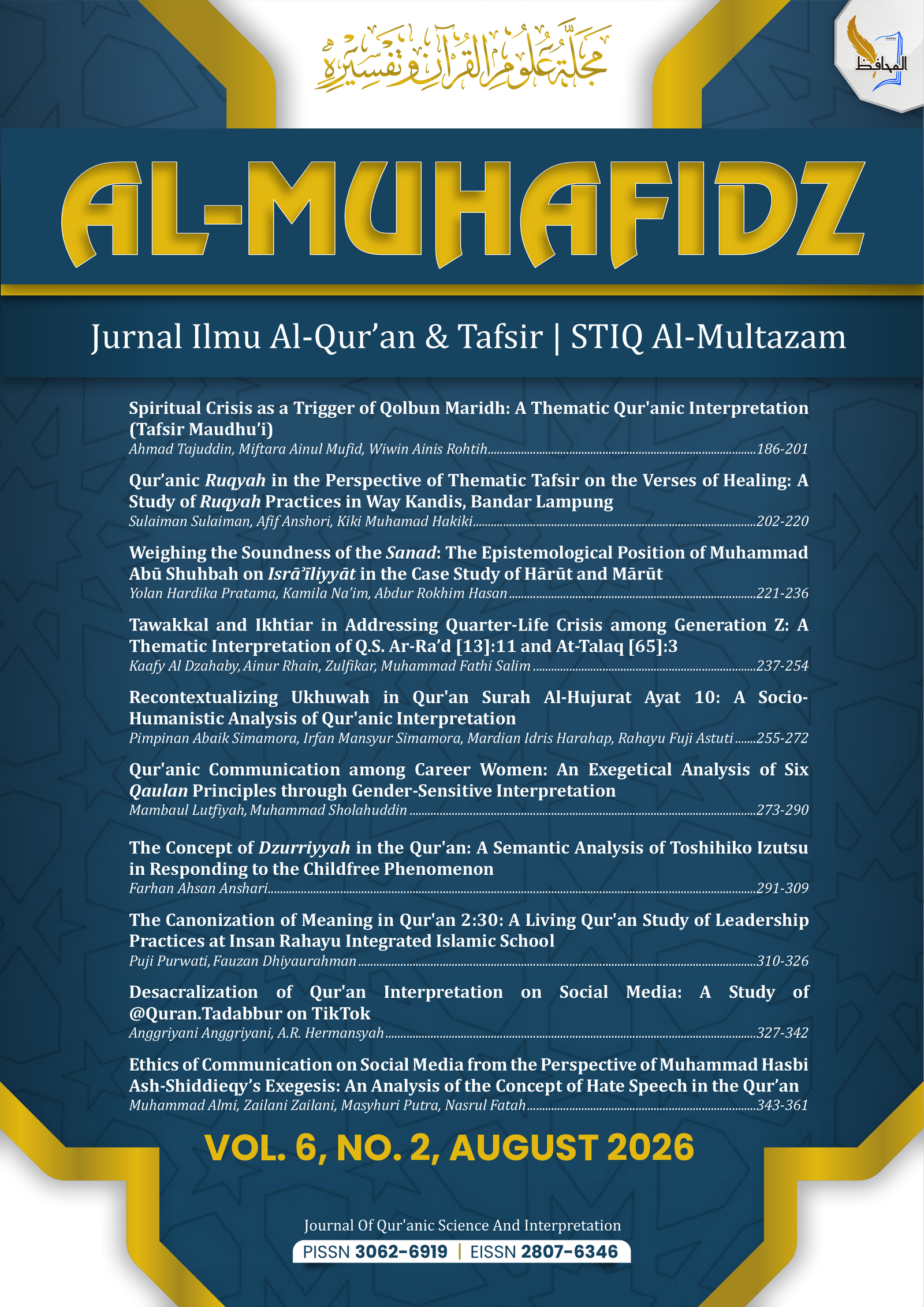
Tawakkal and Ikhtiar in Addressing Quarter-Life Crisis among Generation Z: A Thematic Interpretation of Q.S. Ar-Ra’d [13]:11 and At-Talaq [65]:3
DOI:
https://doi.org/10.57163/4ffkxw51Keywords:
Generation Z, Ikhtiar, Quarter-Life Crisis , Thematic Interpretation (Tafsir Maudhū’i)Abstract
The quarter-life crisis has emerged as a prevalent psychological phenomenon among Generation Z, characterized by anxiety, career uncertainty, identity confusion, and concerns about the future. Existing studies predominantly explain this phenomenon through psychological or general religious coping perspectives, while the integrative Qur'anic relationship between ikhtiar (diligent effort) and tawakkal (reliance on Allah) remains insufficiently explored. This study aims to reconstruct the Qur'anic paradigm of ikhtiar and tawakkal through a thematic interpretation of Q.S. Ar-Ra'd [13]:11 and Q.S. At-Talaq [65]:3, and to examine its relevance as a spiritual coping framework for addressing the quarter-life crisis among Generation Z. This qualitative library research employs the tafsir maudhū’i (thematic interpretation) approach by analyzing the selected Qur'anic verses alongside classical and contemporary tafsir literature and relevant studies on quarter-life crisis, Islamic psychology, and religious coping. The findings demonstrate that ikhtiar functions as an active mechanism encouraging self-development, responsible action, and adaptive responses to uncertainty, whereas tawakkal serves as a spiritual mechanism that alleviates anxiety through trust in Allah after optimal effort has been exerted. Their integration establishes a balanced Qur'anic framework that strengthens psychological resilience, emotional stability, and meaningful engagement with life's uncertainties. The reconstructed paradigm offers a relevant conceptual foundation for helping Generation Z cope with the psychological challenges of the quarter-life crisis. Unlike previous studies that primarily emphasize psychological or general religious coping, this research proposes an integrative Qur'anic spiritual coping model by synthesizing ikhtiar and tawakkal through thematic interpretation, thereby contributing to the development of contemporary Qur'anic exegesis and Islamic psychology.
References
American Psychological Association. Stress in AmericaTM 2023: Generation Z. American Psychological Association, 2023.
Azhari, Fajri Fauzan, Nailah Dhiya Ulhaq, Ghina Ilma Alia, Arsyaddhia Edra Rustam, and Nita Trimulyaningsih. “Islamic Spirituality and Subjective Well-Being among Generation Z.” Proceedings of the 1st International Conference on Social Science (ICSS) 4, no. 1 (2025): 548–59. https://doi.org/10.59188/icss.v4i1.279.
Booth, Andrew, Diana Papaioannou, and Anthea Sutton. Systematic Approaches to a Successful Literature Review. 2nd ed. SAGE Publications Ltd, 2016.
Damayanti, Andia Kusuma, and Alfredo Putut Prahoro. “Career Decision Making and the Quarter-Life Crisis in Generation Z.” International Journal of Research and Innovation in Social Science IX, no. XVII (2025): 112-117-112–17. https://doi.org/10.47772/IJRISS.2025.917PSY0013.
Esguerra, Allen Andrei, Jhon Kensly Dungca, Angelo Castro, et al. “Mediating Role of Coping on the Relationship between Daily Spiritual Experience and Quality of Life among Generation Z.” Journal of Interdisciplinary Perspectives 3, no. 2 (2025): 160–70. https://doi.org/10.69569/jip.2024.0668.
Fikar, Zulfikar, Azifah Nurullah, Nur Alifah Muyasaroh, Athaya Zahra Nayna Ramadhani, and Bilqis Nidaul Khair Daulay. “Interreligious Citizenship Dalam Tafsir QS. Al-Mumtahanah Ayat 8: Rekonstruksi Relasi Muslim Dan Non-Muslim Pada Masyarakat Multikeyakinan.” Basha’ir: Jurnal Studi Al-Qur’an Dan Tafsir 6, no. 1 (2026): 91–102. https://doi.org/10.47498/mb8vce25.
Hasan, Abdullah, and Ainur Rhain. “Thematic Tafsir Approach to the Six Principles of Qaulan in Addressing Digital Hate Speech.” Al-Afkar, Journal For Islamic Studies 9, no. 2 (2026): 2160–73. https://doi.org/10.31943/afkarjournal.v9i2.3414.
Indonesia National Adolescent Mental Health Survey (I-NAMHS). Indonesia National Adolescent Mental Health Survey (I-NAMHS): National Report. Center for Reproductive Health, Universitas Gadjah Mada; Ministry of Health of the Republic of Indonesia; Johns Hopkins Bloomberg School of Public Health, 2022.
Jena, Kiranmayee, and Manoj Kumar Sethi. “The Role of Spirituality and Religiousness in Promoting Mental Health: A Systematic Review.” AIJFR - Advanced International Journal for Research 6, no. 6 (2025). https://doi.org/10.63363/aijfr.2025.v06i06.2657.
Kautsar, Nur‘Alim Muhammad, Jihan Kharisma Hidayatulloh, and Ainur Rhain. “The Terminology of Thuma’ninah in the Qur’an: Al Qurtubi’s Interpretation and Mental Health Relevance.” Al-Afkar, Journal For Islamic Studies 9, no. 2 (2026): 338–52.
Mustaqim, Abdul. Metode Penelitian Al-Qur’an Dan Tafsir. Idea Press, n.d.
Nirwana AN, Andri, Yeti Dahliana, Ainur Rhain, et al. “Mapping Quranic Exegesis Research: Trends, Contributions, and Future Directions.” Jurnal Ilmiah Peuradeun 13, no. 1 (2025): 319–50. https://doi.org/10.26811/peuradeun.v13i1.1250.
Pargament, Kenneth I., Julie J. Exline, and James W. Jones. APA Handbook of Psychology, Religion, and Spirituality. Vol. 1. American Psychological Association, 2021. https://doi.org/10.1037/0000245-000.
Robinson, Oliver. The Quarter-Life Breakthrough: Invent Your Own Path, Find Meaningful Work, and Build a Life That Matters. TarcherPerigee, 2019.
Rosyiddin, Abdul Aziz Ali, and Nur Aziz Afandi. “Quarter-Life Crisis in Generation Z Adults.” Psychology, Mental Health and Research Studies 1, no. 1 (2023). https://doi.org/10.29080/pmhrs.v1i1.1135.
Sadri, Lely Ameliah, Dian Novita Siswanti, and Eka Sufartianinsih Jafar. “Overview of the Quarter Life Crisis in Generation Z Who Are Entering Early Adulthood.” Journal of Correctional Issues (JCI) 7, no. 1 (2024). https://doi.org/10.52472/jci.v7i1.421.
Shihab, M. Quraish. Kaidah Tafsir: Syarat, Ketentuan, Dan Aturan Yang Patut Anda Ketahui Dalam Memahami Al-Qur’an. Lentera Hati, 2019.
Shihab, M. Quraish. Tafsir Al-Mishbah: Pesan, Kesan, Dan Keserasian Al-Qur’an. Vol. 6. Lentera Hati, 2020.
Shihab, M. Quraish. Tafsir Al-Mishbah: Pesan, Kesan, Dan Keserasian Al-Qur’an. Vol. 14. Lentera Hati, 2020.
Soraya, Siti Zazak, and Ratna Nila Puspitasari. “Islamic Coping Stress and Quarter-Life Crisis among Generation Z College Students.” Journal of Education and Learning (EduLearn) 19, no. 1 (2025): 287–93. https://doi.org/10.11591/edulearn.v19i1.21382.
Wahidin, Baso Muh, Ahmad Nurrohim, and Zulfikar Zulfikar. “The Concept Of Tawāzun In Hamka’s Tafsir Al-Azhar And Its Relevance To The Phenomenon Of Hustle Culture.” Community: Jurnal Hasil Penelitian Dan Pengabdian Masyarakat 5, no. 1 (2026): 1009–26.
World Health Organization. “Mental Health of Adolescents.” World Health Organization, 2024. https://www.who.int/news-room/fact-sheets/detail/adolescent-mental-health.
Yaqub, Achmad, Firdaus Firdaus, Deliana Putri, and Widya Astuti. “Hadith-Based Religious Coping Model on Tawakkal: A Neuropsychological Analysis of Stress Reduction Mechanisms.” Hamidah: Jurnal Ilmu Hadis 1, no. 2 (2025): 90–102. https://doi.org/10.64691/v1xk8581.
Zuhaili, Wahbah al-. Tafsir Al-Munir Fi al-’Aqidah Wa al-Shari’ah Wa al-Manhaj. Dar al-Fikr, 2018.
Zuhaili, Wahbah al-. Tafsir Al-Munir Fi al-’Aqidah Wa al-Shari’ah Wa al-Manhaj. Vol. 13. Dar al-Fikr, 2018.
Zuhaili, Wahbah al-. Tafsir Al-Munir Fi al-’Aqidah Wa al-Shari’ah Wa al-Manhaj. Vol. 28. Dar al-Fikr, 2018.
Zulfikar, Zulfikar, Herliana Setyaning Pramesti, Khairunnisa Radhwa Nazihah, Khoirul Harisin, and Muhammad Naufal Zulfikar. “Maqāṣidī Interpretation of Environmental Verses as a Solution to the Ecological Crisis and Global Climate Change.” Ibn Abbas 9, no. 1 (2026): 89–105.
Downloads
Published
Data Availability Statement
The data supporting the findings of this study are derived from publicly available sources, including the Qur'an, classical and contemporary tafsir literature, and scholarly publications cited in the reference list. No new datasets were generated or analyzed during the current study. Therefore, data sharing is not applicable to this research.
Issue
Section
License
Copyright (c) 2026 Kaafy Al Dzahaby, Ainur Rhain, Zulfikar Zulfikar, Muhammad Fathi Salim

This work is licensed under a Creative Commons Attribution 4.0 International License.